
Reading List
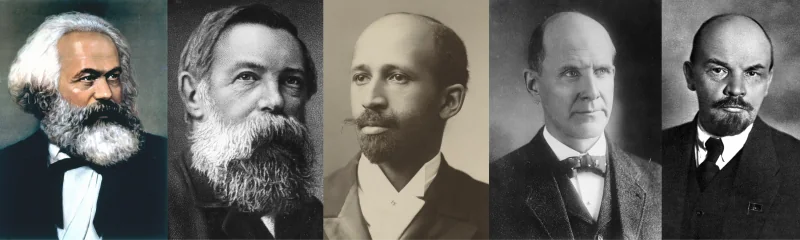
This is a working bibliography for readers interested in scientific socialism, American political economy, labor history, democratic institutions, economic development, technology, and the history of socialist thought in the United States.
It is not intended as a canon or a list of works with which Continental Communist necessarily agrees. A serious materialist analysis benefits from reading primary socialist texts alongside history, economics, liberal theory, conservative criticism, and competing interpretations of capitalism.
The purpose of this list is therefore not merely to recommend books sympathetic to socialism. It is to assemble works that help explain the society in which an American socialist politics would have to operate.
Choose a learning pathway
The bibliography now supports twelve structured routes. Each one includes a level, realistic effort estimate, prerequisites, introductions, scoped readings, written lecture guides, questions, a glossary, and private progress tracking with optional account sync.
Marxism Fundamentals
Learn the basic vocabulary and method of historical materialism, class analysis, value, exploitation, and political power.
- Estimated effort
- 6 weeks · 3–4 hours per week
Capital and Political Economy
Move from the commodity and money through exploitation, accumulation, circulation, competition, crisis, and finance.
- Estimated effort
- 10 weeks · 5–7 hours per week
American Capitalism and the State
Study how constitutional institutions, corporations, infrastructure, public administration, and finance shaped American development.
- Estimated effort
- 8 weeks · 4–5 hours per week
Labor and Socialist History in the United States
Follow American labor from emancipation and agrarian revolt through industrial unionism, socialism, the CIO, and neoliberal decline.
- Estimated effort
- 8 weeks · 4–5 hours per week
Race, Reconstruction, and Class
Examine slavery, emancipation, Reconstruction, racial ideology, labor, citizenship, and the material reproduction of hierarchy.
- Estimated effort
- 7 weeks · 4–5 hours per week
Markets, Planning, and Socialist Democracy
Work through the calculation debate, information problems, institutional design, socialist experience, and democratic coordination.
- Estimated effort
- 8 weeks · 5–6 hours per week
Technology, Automation, and Artificial Intelligence
Analyze technology as a social relation shaped by ownership, management, skill, labor control, public investment, and political choice.
- Estimated effort
- 6 weeks · 4–5 hours per week
Imperialism and Global Development
Compare theories of imperialism, world systems, finance, states, development, and socialist transformation across regions.
- Estimated effort
- 8 weeks · 5–6 hours per week
Marxist-Leninist Core Curriculum
A 24-week intensive study of the primary texts that establish the Marxist-Leninist framework of materialism, political economy, state power, organization, imperialism, national liberation, and socialist transition.
- Estimated effort
- 24 weeks · 6–8 hours per week
Marxist Feminism: Foundations of Gender and Class
A materialist introduction to the relationship between gender oppression, the monogamous family, private property, and class struggle.
- Estimated effort
- 6 weeks · 3–4 hours per week
Marxist Feminism: Social Reproduction Theory
Analyze how capitalism depends upon the unpaid reproduction of labor power, the 1970s domestic labor debate, and the development of unitary social reproduction theory.
- Estimated effort
- 6 weeks · 4–5 hours per week
Marxist Feminism: Global Accumulation, Value, and the State
Examine the international division of reproductive labor, global care chains, subsistence production in the Global South, value-form critiques, and the capitalist crisis of care.
- Estimated effort
- 6 weeks · 5–6 hours per week
Progress stays in your browser by default. A private learner account can synchronize it across devices, but no account is required.
Note: The Marxists Internet Archive is the most important resource ever compiled in digital Marxist education. Much of our reading list on core texts can be found on the site.

Where to Start
Readers new to these subjects may find the following sequence useful:
- Karl Marx and Friedrich Engels — The Communist Manifesto
- Friedrich Engels — Socialism: Utopian and Scientific
- Karl Marx — Wage Labour and Capital
- Karl Marx — Value, Price and Profit
- W. E. B. Du Bois — Black Reconstruction in America
- Karl Polanyi — The Great Transformation
- Eugene V. Debs — Selected Speeches and Writings
- Alexis de Tocqueville — Democracy in America
- Joseph A. Schumpeter — Capitalism, Socialism and Democracy
- Karl Marx — Capital, Volume I
This progression moves from introductory socialist theory toward political economy, American history, institutions, and more advanced Marxist analysis.
I. Foundations of Scientific Socialism
Karl Marx and Friedrich Engels — The Communist Manifesto
The most concise introduction to Marx and Engels’ conception of class conflict, capitalist development, political struggle, and historical change.
Its importance lies less in its nineteenth-century political program than in the historical argument running through it: capitalism is not a permanent social order, but a particular stage of development produced by previous historical transformations.
Friedrich Engels — Socialism: Utopian and Scientific
One of the clearest short introductions to the distinction Marx and Engels drew between utopian socialism and an analysis grounded in historical development, political economy, and class relations.
Karl Marx — Wage Labour and Capital
A short and accessible entry point into Marx’s understanding of wages, labor power, capital, and the relationship between workers and employers.
Karl Marx — Value, Price and Profit
A useful companion to Wage Labour and Capital. Marx explains wages, surplus value, profit, and the economic importance of trade-union struggles.
Karl Marx — Critique of the Gotha Programme
A short but important work on socialism, distribution, political transition, labor, and the relationship between different stages of post-capitalist development.
It is also the source of Marx’s famous distinction between distribution according to contribution and the higher communist principle of distribution according to need.
Karl Marx — The Eighteenth Brumaire of Louis Bonaparte
One of the best examples of Marx applying historical materialism to an actual political crisis.
Rather than reducing politics mechanically to economics, Marx examines class coalitions, political institutions, ideology, state power, and historical circumstance.
Karl Marx — The Civil War in France
Marx’s interpretation of the Paris Commune and one of his major discussions of political power, working-class government, and the structure of the state.
Friedrich Engels — The Origin of the Family, Private Property and the State
An influential early materialist attempt to connect the development of property, family structures, class society, and political institutions.
Some of its anthropology is historically dated, but the work remains important to the development of Marxist social theory.
II. Marx’s Political Economy
Karl Marx — Capital, Volume I
The central work of Marxian political economy.
Topics include:
- Commodity production
- Money
- Labor power
- Surplus value
- The working day
- Machinery
- Accumulation
- Primitive accumulation
- The transformation of labor under industrial capitalism
Readers need not absorb every chapter on the first pass. The sections on commodities, the working day, machinery, accumulation, and primitive accumulation are particularly important.
Karl Marx — Capital, Volume II
Examines the circulation and reproduction of capital.
It is less frequently read than Volume I but becomes increasingly important for understanding the economy as an interconnected system rather than merely the activity of individual firms.
Karl Marx — Capital, Volume III
Addresses profit, interest, commercial capital, rent, competition, and the distribution of surplus value across the capitalist economy.
It contains some of Marx’s most important discussions of financial and industrial organization.
Karl Marx — Grundrisse
A collection of notebooks written while Marx was developing the ideas that became Capital.
Especially important are the sections concerning machinery, technological development, automation, and the increasingly social character of production.
Karl Marx — Theories of Surplus Value
Marx’s extended engagement with earlier political economists.
Useful for readers interested in how Marx’s economics emerged from—and differed from—the classical political economy of Smith and Ricardo.
III. Classical Political Economy
Scientific socialism emerged through a critique of classical political economy. Understanding that tradition makes Marx considerably easier to understand.
Adam Smith — The Wealth of Nations
A foundational work of modern political economy.
Smith’s treatment of specialization, markets, productivity, wages, profit, rent, and economic development provides an essential backdrop to later socialist analysis.
David Ricardo — On the Principles of Political Economy and Taxation
Particularly important for the development of theories of value, wages, profits, and rent.
Ricardo exercised a major influence on Marx.
John Stuart Mill — Principles of Political Economy
An important nineteenth-century synthesis of liberal political economy.
Mill is especially interesting because his economic liberalism coexisted with increasing sympathy for cooperative forms of production.
IV. American Labor and Class History
Any distinctly American socialism requires serious engagement with the history of American workers and industrial development.
Philip S. Foner — History of the Labor Movement in the United States
A multi-volume history covering major episodes in American working-class organization, strikes, political movements, and trade unionism.
David Montgomery — The Fall of the House of Labor
A major history of the transformation of American labor between the nineteenth century and the First World War.
Particularly useful for understanding workplace control, industrial organization, craft traditions, and the development of modern management.
David Montgomery — Workers’ Control in America
Essays on workers’ struggles over authority inside the workplace.
It is especially useful for understanding that labor conflict has historically concerned not only wages but also control over production itself.
Melvyn Dubofsky — We Shall Be All
A major history of the Industrial Workers of the World.
The IWW represents one of the most distinctive traditions of radical labor organization developed in the United States.
Irving Bernstein — The Lean Years
A history of American labor during the difficult years preceding the emergence of the New Deal labor order.
Irving Bernstein — Turbulent Years
A study of the extraordinary wave of labor organization and conflict during the New Deal era.
Nelson Lichtenstein — State of the Union
An examination of organized labor’s rise, institutionalization, and decline in twentieth-century America.
Jefferson Cowie — Stayin’ Alive
A cultural and political history of the American working class during the economic transformations of the 1970s.
Jefferson Cowie — The Great Exception
Argues that the political conditions supporting the New Deal order were historically unusual rather than the natural trajectory of American politics.
V. Reconstruction, Race, and Labor
American class development cannot be understood separately from slavery, emancipation, Reconstruction, migration, and racial hierarchy.
W. E. B. Du Bois — Black Reconstruction in America
One of the most important works of American historical interpretation.
Du Bois analyzes the Civil War and Reconstruction through slavery, labor, class, democracy, and the political role of formerly enslaved people.
His concept of the “general strike” of enslaved laborers remains influential.
Eric Foner — Reconstruction
A comprehensive modern history of Reconstruction.
Essential for understanding the attempt to establish a multiracial democratic order after the Civil War and the forces that ultimately defeated it.
Eric Foner — The Second Founding
A focused examination of the Thirteenth, Fourteenth, and Fifteenth Amendments and their transformation of the American constitutional order.
C. Vann Woodward — The Strange Career of Jim Crow
A classic history of segregation and the development of the Jim Crow order.
Barbara J. Fields and Karen E. Fields — Racecraft
An examination of how racial categories are socially constructed and reproduced.
Particularly useful for readers interested in the relationship between race and material social relations.
VI. The American Socialist Tradition
Eugene V. Debs — Selected Speeches and Writings
Debs remains indispensable for understanding socialism as an American mass political tradition rather than merely an imported ideology.
His speeches combine labor politics, democratic rhetoric, class analysis, and a distinctly American political vocabulary.
Eugene V. Debs — “Canton Speech”
One of the most famous antiwar and socialist speeches in American history.
Daniel Bell — Marxian Socialism in the United States
A major historical interpretation of why socialist movements struggled to establish themselves permanently in American political life.
Bell’s conclusions should be read critically, but the historical problem he examines is fundamental.
Michael Harrington — The Other America
A study of poverty amid postwar American prosperity.
The book had a significant influence on public discussion surrounding the War on Poverty.
Michael Harrington — Socialism
A twentieth-century American interpretation of democratic socialism and socialist intellectual history.
John Nichols — The “S” Word
A popular history emphasizing the often-overlooked role of socialist ideas and politicians in American history.
James Weinstein — The Decline of Socialism in America, 1912–1925
A history of the Socialist Party during the period following its high point in early twentieth-century American politics.
VII. American Populism and Agrarian Radicalism
American anti-capitalist politics did not develop solely through industrial socialism.
Lawrence Goodwyn — The Populist Moment
A major interpretation of the late nineteenth-century Populist movement.
Goodwyn emphasizes cooperative institutions, political education, farmer organization, and democratic economic reform.
Charles Postel — The Populist Vision
A revisionist history emphasizing the modernizing rather than purely nostalgic character of Populist politics.
Elizabeth Sanders — Roots of Reform
Examines agrarian political movements and their contribution to the development of the American regulatory state.
VIII. Democracy and the American Constitutional Order
A socialism appropriate to the United States must understand the institutions through which American political power actually operates.
The Federalist Papers
The foundational defense of the constitutional structure created in 1787.
Particularly important are the discussions of factions, representation, federalism, executive power, and institutional design.
Alexis de Tocqueville — Democracy in America
One of the most influential analyses of American political culture.
Tocqueville examines equality, local government, voluntary associations, religion, individualism, majority rule, and democratic habits.
Charles A. Beard — An Economic Interpretation of the Constitution of the United States
A historically influential attempt to understand the Constitutional Convention in terms of the economic interests of its participants.
Many of Beard’s specific conclusions have been challenged, but the broader question of material interests and constitutional development remains important.
Gordon S. Wood — The Radicalism of the American Revolution
An interpretation of the social transformations produced by the American Revolution.
Bernard Bailyn — The Ideological Origins of the American Revolution
A classic account emphasizing the political ideas and intellectual traditions shaping revolutionary America.
Reading Wood, Bailyn, and Beard together provides sharply contrasting interpretations of the same foundational period.
IX. Capitalism and American Economic Development
Alfred D. Chandler Jr. — The Visible Hand
A major history of the rise of the modern managerial corporation.
Chandler shows how large organizations increasingly replaced market coordination with administrative planning inside firms.
Alfred D. Chandler Jr. — Scale and Scope
A comparative history of large industrial enterprises and the organizational structures required by modern production.
William Cronon — Nature’s Metropolis
A history of Chicago and its economic relationship with the American West.
An excellent study of markets, transportation, commodities, geography, and capitalist development.
Sven Beckert — Empire of Cotton
A global history of cotton capitalism connecting slavery, industrialization, trade, empire, and modern economic development.
Louis Hyman — Debtor Nation
A history of consumer credit and the transformation of American household finance.
Louis Hyman — Temp
An account of the development of contingent labor and the changing structure of employment in the United States.
X. The New Deal and the American Political Economy
Arthur M. Schlesinger Jr. — The Age of Roosevelt
A classic multi-volume history of the New Deal era.
Alan Brinkley — The End of Reform
Examines the transformation of American liberalism from structural economic reform toward a politics more accepting of large-scale corporate capitalism.
Ira Katznelson — Fear Itself
A history of the New Deal and wartime political order emphasizing the complicated congressional coalition on which Roosevelt depended.
Meg Jacobs — Pocketbook Politics
Examines the politics of prices, consumption, inflation, and purchasing power in twentieth-century America.
XI. Monopoly, Corporate Power, and Finance
Rudolf Hilferding — Finance Capital
An early Marxist analysis of banking, industry, monopoly, and financial concentration.
Vladimir Lenin — Imperialism, the Highest Stage of Capitalism
A highly influential argument connecting monopoly capitalism, finance, colonialism, and international rivalry.
It should be read alongside more recent economic histories rather than treated as the last word on the subject.
Paul Baran and Paul Sweezy — Monopoly Capital
A major twentieth-century attempt to update Marxian political economy for an economy dominated by large corporations.
John Kenneth Galbraith — The New Industrial State
Galbraith argues that advanced industrial corporations depend heavily on planning, technical expertise, and bureaucratic organization rather than simple competitive markets.
John Kenneth Galbraith — American Capitalism
Introduces the concept of “countervailing power” among corporations, labor unions, government, and other large institutions.
XII. Markets, Planning, and Economic Coordination
The socialist calculation debate remains important for any serious discussion of economic organization.
Ludwig von Mises — Economic Calculation in the Socialist Commonwealth
One of the foundational arguments against comprehensive socialist planning.
Mises argues that meaningful economic calculation becomes impossible without market prices for capital goods.
Friedrich Hayek — “The Use of Knowledge in Society”
A central argument that economic knowledge is dispersed among individuals and cannot easily be centralized.
Even readers who reject Hayek’s broader politics should take this problem seriously.
Oskar Lange — On the Economic Theory of Socialism
A major socialist response to the economic-calculation critique.
Lange attempts to show how public ownership and price mechanisms might coexist.
Alec Nove — The Economics of Feasible Socialism
A pragmatic investigation of how a socialist economy might actually coordinate complex production.
Nove is particularly useful because he focuses on institutional feasibility rather than ideal models.
János Kornai — The Socialist System
A major analysis of the institutional characteristics and recurring economic problems of Soviet-style planned economies.
XIII. Capitalism, Socialism, and Democracy
Joseph A. Schumpeter — Capitalism, Socialism and Democracy
One of the most important twentieth-century books on capitalist development.
Schumpeter’s analysis of innovation, entrepreneurship, bureaucracy, democracy, and the possible transformation of capitalism is valuable regardless of whether one accepts his conclusions.
Karl Polanyi — The Great Transformation
Polanyi argues that attempts to construct a self-regulating market society provoke social reactions because labor, land, and money cannot be treated like ordinary commodities without destabilizing society.
Albert O. Hirschman — The Passions and the Interests
A history of the intellectual arguments through which commerce and economic self-interest came to be viewed as forces capable of moderating political passions.
Albert O. Hirschman — Exit, Voice, and Loyalty
A compact framework for thinking about how individuals respond to declining institutions and organizations.
XIV. Technology, Automation, and Production
Scientific socialism has always been concerned with the development of productive forces. That question becomes especially important in an era of artificial intelligence and automation.
Karl Marx — “Fragment on Machines” in the Grundrisse
Marx speculates about increasingly automated production, scientific knowledge, machinery, and the declining importance of direct human labor in highly developed industry.
David F. Noble — Forces of Production
A history of industrial automation and the politics surrounding technological choices in manufacturing.
Noble emphasizes that technology is shaped by managerial and social priorities rather than developing independently of them.
Harry Braverman — Labor and Monopoly Capital
An influential Marxist study of management, deskilling, workplace control, and the organization of labor in advanced capitalism.
Shoshana Zuboff — In the Age of the Smart Machine
An early examination of the transformation of work under computerization.
Erik Brynjolfsson and Andrew McAfee — The Second Machine Age
A mainstream economic treatment of digital technology, automation, productivity, and labor-market disruption.
Reading it alongside Marxist accounts helps distinguish empirical technological developments from competing interpretations of their social consequences.
XV. Imperialism and the International Political Economy
J. A. Hobson — Imperialism
An influential early economic interpretation of imperial expansion.
Vladimir Lenin — Imperialism, the Highest Stage of Capitalism
A Marxist synthesis of monopoly, finance capital, export of capital, and great-power rivalry.
Giovanni Arrighi — The Long Twentieth Century
A large-scale historical analysis of capitalism, financial expansion, and successive centers of global economic power.
Immanuel Wallerstein — The Modern World-System
An influential attempt to analyze capitalism as an international system structured around core, semi-peripheral, and peripheral regions.
Robert Gilpin — Global Political Economy
A useful non-Marxist introduction to international economic relations, states, markets, and competing theories of global political economy.
XVI. Socialist Experiences Outside the United States
Understanding socialism internationally is necessary, but foreign experiences should be studied historically rather than treated as templates for American politics.
V. I. Lenin — State and Revolution
A major Marxist argument about the state, revolution, democracy, and political transition.
Leon Trotsky — The History of the Russian Revolution
A participant’s detailed political history of the Russian Revolution.
E. H. Carr — The Bolshevik Revolution
A major scholarly history of the early Soviet period.
Isaac Deutscher — The Prophet Trilogy
A three-volume biography of Leon Trotsky and a broad history of revolutionary Marxism in the early twentieth century.
Maurice Meisner — Mao’s China and After
A historical study of the Chinese Revolution, Maoist period, and subsequent economic transformation.
Ezra Vogel — Deng Xiaoping and the Transformation of China
A detailed account of China’s turn toward market-oriented reform and rapid industrial development.
These works are especially useful when read comparatively rather than devotionally.
XVII. Social Democracy and the Welfare State
Gøsta Esping-Andersen — The Three Worlds of Welfare Capitalism
A comparative study of welfare-state institutions and their relationship to labor markets and class structures.
Sheri Berman — The Primacy of Politics
A history of European social democracy and the political debates that separated democratic socialist traditions from both orthodox Marxism and laissez-faire liberalism.
Tony Judt — Postwar
A broad history of Europe after the Second World War, including the development of welfare states, social democracy, Christian democracy, and European integration.
XVIII. Modern Inequality and Capital
Thomas Piketty — Capital in the Twenty-First Century
A large empirical study of wealth, income, inheritance, and long-run inequality.
Piketty is not a Marxist, which makes the book particularly useful for comparison with Marxian theories of accumulation.
Thomas Piketty — Capital and Ideology
Extends the earlier analysis toward political institutions, property regimes, ideology, and historical systems of inequality.
Branko Milanović — Global Inequality
An empirical study of inequality both within countries and across the international economy.
Emmanuel Saez and Gabriel Zucman — The Triumph of Injustice
A study of taxation, wealth, and distribution in the United States.
XIX. Conservative and Liberal Critiques
A political tradition becomes intellectually weaker when it only reads itself.
These books represent major arguments against socialism, economic planning, or radical institutional transformation.
Friedrich Hayek — The Road to Serfdom
A classic liberal argument that centralized economic control threatens political freedom.
Friedrich Hayek — The Constitution of Liberty
A broader statement of Hayek’s political philosophy and conception of a free society.
Milton Friedman — Capitalism and Freedom
A concise defense of markets, limited government, and the relationship between economic and political liberty.
Robert Nozick — Anarchy, State, and Utopia
An influential philosophical defense of strong individual property rights and the minimal state.
Edmund Burke — Reflections on the Revolution in France
A classic conservative argument concerning inherited institutions, gradual change, political abstraction, and revolutionary transformation.
Michael Oakeshott — “Rationalism in Politics”
A philosophical critique of the idea that political institutions can simply be redesigned according to abstract theory.
These arguments are worth reading precisely because questions of knowledge, institutional complexity, political power, and unintended consequences are genuine problems for socialist politics.
XX. Method, History, and Social Analysis
E. H. Carr — What Is History?
A concise introduction to historical interpretation, evidence, causation, and the relationship between historians and their subjects.
Marc Bloch — The Historian’s Craft
A classic reflection on how historical knowledge is produced.
C. Wright Mills — The Sociological Imagination
A powerful argument for connecting individual experience with larger institutional and historical structures.
C. Wright Mills — The Power Elite
An influential study of concentrated institutional power in American political, corporate, and military life.
Barrington Moore Jr. — Social Origins of Dictatorship and Democracy
A comparative historical analysis of the different political outcomes associated with class structures and economic development.
Theda Skocpol — States and Social Revolutions
A major comparative analysis of revolution emphasizing states, institutions, international pressures, and class relations.
XXI. Useful American Primary Sources
Political theory is easier to understand when read alongside the actual documents through which American institutions developed.
Recommended primary sources include:
- The Declaration of Independence
- The Articles of Confederation
- The Constitution of the United States
- The Federalist Papers
- George Washington’s Farewell Address
- Abraham Lincoln’s major speeches
- Frederick Douglass’s speeches and writings
- The Reconstruction Amendments
- The Populist Party’s Omaha Platform
- Eugene V. Debs’s speeches
- Franklin D. Roosevelt’s Commonwealth Club Address
- Franklin D. Roosevelt’s Second Bill of Rights speech
- Martin Luther King Jr.’s later speeches on labor, poverty, and economic justice
These documents help locate socialist arguments within the broader development of American political language.
XXII. Structured Learning Pathways
The former suggested reading sequences have been developed into nine complete Learning Pathways.
The pathways preserve the breadth of this bibliography while adding a level, estimated effort, prerequisites, introductions, summaries, discussion questions, written lecture guides, contextual glossaries, and progress tracking.
Readers new to the subject should begin with Marxism Fundamentals. Readers who complete it can continue through the 24-week Marxist-Leninist Core Curriculum. Readers with prior grounding can also choose a pathway by subject and level.
Reading Across Traditions
Continental Communist approaches scientific socialism as a method of inquiry rather than a requirement to defend every position historically associated with the socialist movement.
For that reason, this reading list deliberately contains authors who disagree profoundly with one another.
Marx should be read alongside Smith.
Lange should be read alongside Hayek.
Debs should be read alongside Tocqueville.
Beard should be read alongside Bailyn and Wood.
Socialist histories should be compared with liberal and conservative interpretations of the same events.
The objective is not to accumulate quotations supporting conclusions already reached. It is to understand historical development well enough to reach better conclusions.
Scientific socialism, if it is to remain scientific, must be capable of confronting evidence, criticism, institutional complexity, technological change, and historical experience.
This bibliography will continue to grow as Continental Communist develops.